If you are involved in a crash with a rideshare vehicle, the path to compensation is usually uniquely challenging. Unlike a standard car accident, your legal action may involve multiple unique considerations, including regulations governing transportation network companies (TNCs). Knowing when and how to file a lawsuit against Uber or Lyft is key to protecting your rights.
The legal team at Gauthier & Maier Law Firm, P.C., uses its experience to navigate this corporate maze and pursue the full compensation you deserve. While rideshare companies treat their drivers as independent contractors, an Uber or Lyft car accident lawyer can still pursue their insurers to seek fair compensation on your behalf.
Key Takeaways Involving Lawsuits After an Uber or Lyft Accident
- Uber and Lyft drivers are deemed independent contractors, so lawsuits require careful evaluation of insurance coverage, corporate liability, and the driver’s status at the time of the crash.
- Evidence like police reports, rideshare company logs, dashcam footage, and cell phone records is key to building a strong case.
- The filing process involves pre-litigation investigation, insurance claims, potential arbitration for passengers, discovery, and litigation.
- A fair outcome should address immediate needs and ongoing care requirements.
- Contact your Uber or Lyft accident attorney to help manage the lawsuit process and pursue meaningful recovery.
How Do Accidents Involving Uber and Lyft Vehicles Happen?
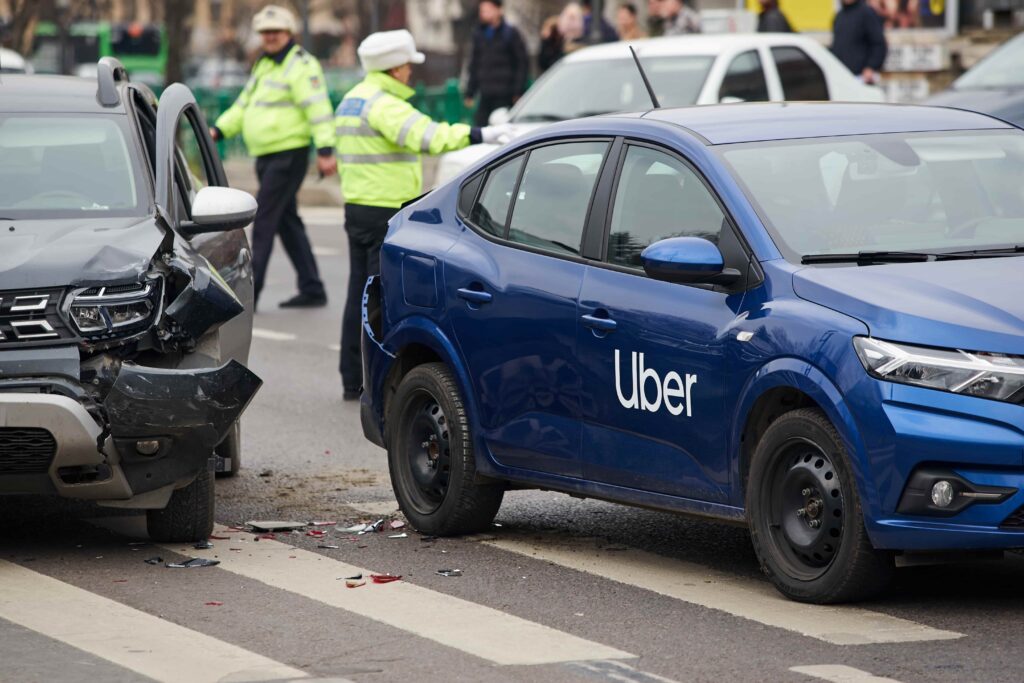
Accidents involving Uber and Lyft vehicles often result from driving behaviors and conditions directly linked to the demands of rideshare work. While these drivers are required to follow the same traffic laws as all motorists, the structure of ridesharing creates distinct risk factors that frequently contribute to serious collisions. Here are the common causes of rideshare accidents:
Driver Distraction From Rideshare Applications
Rideshare drivers depend heavily on mobile applications to perform their jobs. Accepting ride requests, following GPS navigation, checking passenger messages, and monitoring trip status all require interaction with a smartphone.
A very slight glance away from the road can significantly reduce reaction time, increasing the likelihood of rear-end collisions, lane departures, and missed traffic signals. With Uber and Lyft drivers, this constant digital engagement makes distraction one of the leading causes of accidents involving Uber and Lyft.
Driver Fatigue From Long or Irregular Hours
Many Uber and Lyft drivers work extended shifts or drive during late-night and early-morning hours. Fatigue reduces alertness, slows decision-making, and impairs coordination, all of which increase the risk of crashes. Tired drivers may fail to notice changing traffic conditions or may react too slowly to sudden hazards. Drivers commonly cause fatigue-related accidents on highways and during overnight hours when visibility is low.
Speeding and Aggressive Driving Behavior
Pressure to complete more trips or meet time-based incentives can encourage rideshare drivers to speed or drive aggressively. This may include tailgating, rapid lane changes, or attempting to beat traffic signals. Speeding reduces a driver’s ability to stop safely and increases the severity of injuries in the event of a crash. Aggressive driving also raises the risk of multi-vehicle accidents, especially in congested urban areas.
Unsafe Passenger Pickup and Drop-Off Practices
Accidents frequently occur when rideshare drivers stop abruptly to pick up or drop off passengers. Drivers may pull over in traffic lanes, stop in no-parking zones, or make sudden turns without adequate signaling. These actions can surprise other drivers and lead to rear-end collisions or side-impact crashes. High-traffic areas such as downtown streets, airports, and event venues are especially prone to these incidents.
Impaired Driving by a Rideshare Driver
Although rideshare companies prohibit driving under the influence, drug-impaired driving still contributes to some Uber and Lyft accidents. Alcohol and some prescription medications can impair judgment, reaction time, and motor skills. When impairment is involved, liability may extend beyond the driver and trigger higher levels of rideshare insurance coverage, depending on whether the app was active at the time of the crash.
What Evidence Is Needed to Sue Lyft or Uber?
Successfully suing Uber or Lyft after a car accident requires more than proving that a crash occurred. You must present clear, credible evidence showing how the crash happened, who was responsible, and how the rideshare driver’s conduct contributed to your injuries. Because rideshare companies aggressively defend claims, each category of evidence plays a specific role in strengthening your case. An experienced car accident lawyer understands how to gather and present this evidence effectively to build a winning case.
- Police accident reports
- Rideshare company incident reports
- Accident scene photos and videos
- Surveillance and traffic camera footage
- Dashcam or in-vehicle camera footage
- Eyewitness testimony
- The Uber or Lyft driver’s cell phone records
- Rideshare company mobile application logs
- Alcohol or drug testing results for the rideshare driver
- Medical records documenting accident-related injuries
- Post-crash vehicle inspection reports
- Accident reconstruction reports and visualizations
Together, this evidence forms the foundation of a strong Uber or Lyft accident lawsuit. Each piece of documentation helps corroborate your version of events and counters attempts by insurers or rideshare companies to shift blame or minimize liability. An Uber or Lyft car accident attorney will collect and present the evidence strategically to strengthen your case and improve your chances of a favorable verdict.
How Do I Sue Uber or Lyft Following an Accident?

Initiating a lawsuit against a transportation network company (TNC) is a complex and challenging process that requires navigating unique rules and taking strategic action. The process diverges slightly from a standard auto accident claim due to corporate structures designed to limit liability. Your attorney must therefore adopt a multi-phase approach in litigating your case.
Here are the main steps to filing a lawsuit for an Uber or Lyft accident:
Pre-Litigation Investigation & Insurance Claim
Before you can initiate an insurance claim, your attorney must perform a forensic-level investigation to establish the driver’s status and identify the correct insurance coverage. Uber and Lyft use a three-phase insurance model. Usually, this involves the following:
- Period 0 (App Off): The driver’s personal insurance applies.
- Period 1 (App On, Waiting for Trip): The company provides a limited contingent liability policy. These are the state-mandated minimums, such as $50,000/$100,000/$25,000 in New Mexico.
- Period 2 (On Trip/En Route to Passenger): The company’s commercial liability policy typically applies, providing coverage of up to $1 million.
Your attorney will immediately send spoliation letters to preserve all app data, GPS logs, and driver records. Concurrently, they will submit claims to the relevant insurer. Most claims resolve in this phase, but if the insurer denies the claim, makes a low-ball offer, or disputes the driver’s status, the case moves to litigation. Your lawyer will handle communications, negotiate on your behalf, and prevent you from making statements that can undermine your case.
Filing the Lawsuit & Overcoming Arbitration Clauses
This is where experience and knowledge become indispensable. A passenger injured in a crash almost always signs a Terms of Service agreement, which includes a mandatory arbitration clause, forcing claims out of public court and into private arbitration.
However, this usually does not apply to third parties, such as other drivers, pedestrians, or cyclists. If you are suing as an injured passenger, your attorney will first file a demand for arbitration through the designated firm as the contract requires. However, we can often argue for skilled circumstances to proceed in court. For non-passengers, the civil complaint is filed directly in the appropriate court of law.
The lawsuit will name both the driver for direct negligence and Uber or Lyft under the legal theory of respondeat superior, or vicarious liability. The legal argument is that the driver was an agent acting within the course and scope of their employment. Your legal advocate will actively challenge the company’s claim that the driver was an independent contractor rather than an employee.
Discovery & Litigation
Once in the legal system, your advocate will engage in intense discovery, demanding internal company documents on driver training, safety policies, background check procedures, and prior incident reports. They depose the driver and corporate representatives. The goal is to prove not only the driver’s negligence but also that Uber or Lyft’s business model or negligent hiring/supervision contributed to the crash. Most cases settle during this phase, but your lawyer will prepare every case for trial to maintain maximum leverage during negotiation.
Throughout the process, your attorney will also address procedural deadlines, such as statutes of limitations and evidence preservation requirements. Missing a filing deadline or failing to secure digital rideshare data promptly can severely weaken a case. By managing the lawsuit from investigation through trial, a rideshare accident lawyer ensures your claim is positioned for maximum financial recovery while protecting your legal rights at every stage.
How Much Is the Compensation for an Uber Passenger Accident Lawsuit?
There is no standard settlement amount for an Uber or Lyft passenger accident. The value of your claim is calculated based on the same core factors as any other auto collision. The final award is the product of a detailed assessment of your specific damages. The key determinants of your compensation include:
- Severity and Permanency of Injuries: Catastrophic injuries that result in permanent disability warrant settlements in the high hundreds of thousands to millions, as they encompass lifelong medical care, lost earning capacity, and intense pain and suffering.
- Total Economic Losses: The sum of all past and projected future medical expenses, rehabilitation costs, lost income, and loss of future earning capacity. For permanent injuries, a medical economist must draft a Life Care Plan.
- Liability Clarity: If the liability is clear and undisputed, it may result in faster and higher settlements. Disputed liability in cases of multi-vehicle pile-ups with shared fault can reduce value or prolong negotiations.
- Insurance Policy Limits: The availability of a higher policy limit for Uber and Lyft cases means you can potentially secure much more compensation, provided there is sufficient evidence to support your claims for damages.
- Defendant Actions: If evidence emerges that Uber or Lyft negligently hired a driver with a dangerous record or knowingly allowed an unsafe vehicle on the road, you may have a claim for punitive damages. These are not for compensation but to punish egregious corporate misconduct and can significantly increase the total recovery.
Essentially, a fair outcome does not require digging into your pocket to cover future accident-related expenses. It must be structured to provide for decades of medical care, adaptive living, and financial stability. Your rideshare accident attorney can utilize medical and economic professionals to build a full future cost projection so that the final verdict reflects a real magnitude of impact.
Frequently Asked Questions: Uber or Lyft Injury Accident Claims
Will Uber or Lyft pay for my medical bills immediately after the crash?
Not necessarily, though their insurance may provide temporary or partial coverage. Their insurer’s duty is to settle the entire claim once, as they are ultimately responsible for these costs as part of your final settlement. In the interim, you should use your own health insurance, MedPay, or PIP coverage. Your attorney can help arrange treatment with medical providers who will defer billing and place a lien on your future settlement.
Do I still need a lawyer if the rideshare driver admits fault?
Even if the driver admits fault, you still require legal guidance if you need to secure fair compensation. While admitting fault sounds positive, insurance companies usually try to minimize your payout. A rideshare accident lawyer calculates all damages accurately. They also handle all communication with insurers and protect you from settling for less than you deserve.
What if Uber or Lyft disputes the severity of my injuries?
You can still pursue full compensation even if the insurance company challenges your medical claims. Your lawyer can work with medical professionals, accident reconstruction specialists, and vocational professionals to substantiate the severity and long-term impact of your injuries. This can bolster your case and increase your chances of a fair settlement.
Call a Rideshare Accident Lawyer Today
Secure legal representation from the start to protect your rights in a successful rideshare accident lawsuit. The lawyers at Gauthier & Maier Law Firm, P.C. understand how Uber and Lyft accident claims work and how to pursue compensation from all available insurance sources. Your attorney can collect and present key evidence and position your case for maximum financial recovery. Contact a lawyer today to discuss your case and file your lawsuit right away.